When looking back in the history or human progress, I have been always fascinated by the use of natural concepts in order to redesign or help new knowledge and methods come to life. And for those times and individuals that listened actively. But while metaphysics would collect first impressions, we can use much more powerful “first expressions” when we become part of the experiment. Today we are constantly bombarded by the “inspired by nature” maketing claim. A type of metaphysical label, often an analogous interpretation. But rarely a path matter and beings would go.
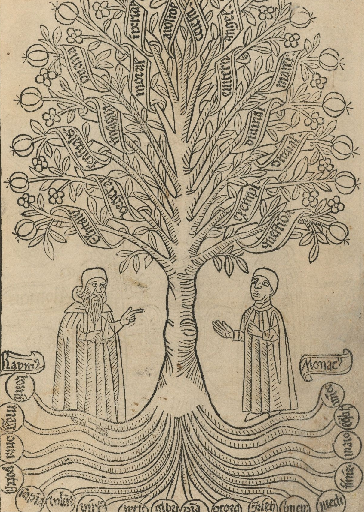
In the medieval scholar’s quest to harmonize knowledge, Ramon Llull (1232–1316) developed one of history’s most prescient formal systems—the Arbor Scientiae, or Tree of Science, written in Rome between 1295 and 1296. His goal to reconcile all faiths and ideas of the time, was already a product of the divine nature of induction: there was an order of things to be mapped. A system to connect all the living creatures for the good, premise by which he departed from the accumulation of knowledge.
So while textbooks credit modern computer scientists with inventing decision trees and probabilistic state-based reasoning models, Llull’s arboreal ontology prefigures both artifacts by nearly seven centuries. His work reveals how knowledge can be organized as functional hierarchies of nested principles, where inference flows sequentially from foundational axioms through intermediate states toward specific conclusions—a conceptual architecture that modern machine learning would later operationalize.
.
The Tree as Decision Hierarchy /
The Arbor Scientiae organizes all human knowledge into sixteen interconnected trees, each representing a domain of science from the elemental to the divine. Within each tree, Llull employs a seven-part organic structure: roots (foundational principles), trunk (unified whole), branches (divisions), twigs (subdivisions), leaves (accidents or properties), flowers (instruments), and fruit (outcomes). This is not merely metaphorical; it is a rigorous template for descending a decision space.
Consider the elementary tree. Its roots consist of eighteen principles derived from Llull’s Ars Magna—abstract notions like Goodness, Greatness, Duration, Power, and Wisdom, supplemented by relational principles such as Difference, Concordance, and Contrariety. As one moves from roots to branches to fruit, each level refines and specifies. In the Elemental Tree, for instance, branches contain the four classical elements, twigs identify compound elements, and fruit manifest in concrete phenomena. Each step is a decision point: to understand a particular phenomenon, one traverses the tree, selecting among branches and leaves until reaching the specific fruit that matches the inquiry.
This hierarchical decomposition mirrors the modern decision tree, where a root node houses a general principle, internal nodes test relations or properties (the tree’s branches), and leaf nodes output classifications or specific cases (the fruit). Llull’s seventeen hierarchical levels and combinatorial checks anticipate the splitting criteria and pruning logic that machine learning algorithms apply today.
.
Sequential Reasoning and the Ladder of Being /
The Arbor Scientiae is not a static taxonomy but a sequential system where knowledge propagates through layers of being seeking completeness. Llull inherited from medieval philosophy the concept of the scala entis—a “ladder of being” ascending from elements, through plants and animals, through human reason, through angels, to God. Each rung embodies the prior rungs, but in increasingly refined form.
Crucially, this hierarchy is relational and inferential. A principle defined at one level carries forward and transforms at the next. Goodness at the elemental level (basic material properties) becomes vegetative goodness (growth and reproduction), then sensory goodness (perception and feeling), human goodness (reason and virtue), and finally divine Goodness (perfect being). The system allows—even demands—traversal in both directions: one ascends from sensory observation to abstract principle, then descends to apply that principle to new domains.
This bidirectional flow between abstraction and particularity parallels the inference mechanisms of modern probabilistic graphical models. In these systems, one observes particular evidence (like sensations), propagates information upward to infer hidden states or causes (like abstract principles), and then descends again to predict new observations or outcomes. Llull formalized this process through correlatives—triadic structures of agent, patient, and action—that explain how a principle active at one level connects to its passive reception and connective operation at another.
.
Correlatives as State-Based Transitions /
The correlatives deserve special attention because they encode something akin to state transitions. Every entity, Llull argued, has a nature defined by three inseparable moments: its active power (bonificativus—that which makes good), its passive susceptibility (bonificabilis—that which is capable of being made good), and its connective action (bonificare—the doing of goodness itself). These three correlatives are not static properties; they are dynamic moments that co-occur and evolve together.
In the Sensual Tree, the eye functions through Visituvus (the seeing faculty), Visibilis (the visible property in objects), and Videre (the act of seeing). The eye’s internal activity meets external receptivity through the connecting act. This three-moment cycle, embedded within each level of the hierarchy, enforces a kind of structured transition: from potential (passive) through actualization (active) to realization (connective). An agent cannot act without a receptive patient; neither exists in isolation. This is sequential reasoning: state A → state B → outcome C, with each stage necessitated by the prior.
Expand this to the full sixteen-tree system, and one finds layers of nested state transitions. The moral tree’s virtues (justice, prudence, fortitude, temperance) are correlative pairs or triples that condition one another; vice arises not from independent wickedness but from the corruption of these relational states. To reason about virtue requires traversing the ladder: observe a human action (sensory level), ascribe it a moral form (human/moral level), check it against the active-passive-connective structure, and determine whether it preserves or violates the coherence of the system. This is inference over hidden states, grounded in relational constraints.
.
The Hundred Forms and Ontological Isomorphism /
Late in each tree, Llull introduces a list of one hundred forms—abstract universals applicable across domains—grouped in pairs or triplets (unity/plurality, simplicity/composition, power/object/act). These forms codify relationships between trees. What unites all domains is that they share the same relational skeleton. This principle of isomorphism across levels is essential for Llull’s system to function as a unified knowledge engine.
Modern machine learning exploits isomorphism when a neural network learns hierarchical representations: low-level features (edges, textures) combine into mid-level motifs (faces, objects), which compose into high-level concepts (scenes, meanings). The network discovers that the same relational patterns recur at every scale. Llull, centuries earlier, posited this as a metaphysical principle: creation is “relational” because it mirrors divine attributes through increasingly specific instantiations. To learn or reason is to recognize these same patterns unfolding across domains.
.
From Algebra to Inference /
What made Llull’s Arbor Scientiae revolutionary was not its success—contemporaries found it bewilderingly complex—but its ambition: to reduce all knowledge to mechanical principles that could be combined and interrogated algorithmically. The work was a failure, in one sense; it did not convert infidels or unify theology and logic. Yet it succeeded in a deeper way: it demonstrated that a finite alphabet of principles, ordered hierarchically and related through correlatives, could generate novel truths by rigorous manipulation. This is the dream of artificial intelligence made flesh in medieval ink.
Seen through modern eyes, the Arbor Scientiae is neither mysticism nor allegory. It is an early programming language for knowledge representation and inference—one that encodes decision hierarchies, sequential state transitions, and relational constraints into a unified ontology. Whether one calls its operations “combinatorics,” “inference,” or “tree search,” Llull’s system anticipates our contemporary obsession with structuring knowledge as nested hierarchies and exploiting their regularities for reasoning and learning. In this sense, Llull was not merely a precursor of modern computer science; he was its first, and perhaps most ambitious, theorist.
- Priani E. Ramon Llull. In: Zalta EN, editor. Stanford Encyclopedia of Philosophy. Spring 2017 Edition. Available from: https://plato.stanford.edu/entries/llull/
- Bonner A. What was Llull up to? In: Fidora A, Sierra C, editors. Ramon Llull: From the Ars Magna to Artificial Intelligence. Barcelona: IIIA-CSIC; 2011.
- Sales T. Llull as computer scientist, or why Llull was one of us. In: Fidora A, Sierra C, editors. Ramon Llull: From the Ars Magna to Artificial Intelligence. Barcelona: IIIA-CSIC; 2011.
- Bonner A. The structure of the Arbor Scientiae. In: Ramon Llull Database, University of Barcelona; [cited 2026 Jan 23]. Available from: https://www.ub.edu/llulldb/docs/Arbor%20scientiae%20Freiburg.pdf
- Llull R. Ars generalis ultima. Pisa: Franciscan Order; 1308.
- Llull R. Ars brevis. Rome; 1296.
- Llull R. Arbor Scientiae. Rome; 1295–1296.
- Llull R. Liber de ascensu et descensu intellectus. Genoa; 1305.
- Gayá C. Escritos fundamentales sobre el Lulismo. Palma de Mallorca: Editorial Anuari Lulià; 2008. [In Spanish]
- Dominguez Reboiras F, Gayá C. Estudios sobre la vida de Ramón Llull. Barcelona: Universitat Autònoma de Barcelona; 2008.
Leave a Reply